Crop & demand
Define what will be grown, when it is needed, and how it should arrive. Varieties, crop cycles, pack formats and customer requirements shape the production brief.
A productive campus begins with a crop, a market and a place. Its buildings, resources and daily operations are designed around those three things.
This is how the parts come together—and the decisions that make each campus fit its location.
A greenhouse can free production from dependence on fertile soil. The site still has to make sense for water, energy, people and the market it serves.
We look for opportunities to turn marginal land into productive growing space close to demand. Crop choice, expected volumes and buyers’ requirements inform the growing area, packing capacity and delivery plan together.
Define what will be grown, when it is needed, and how it should arrive. Varieties, crop cycles, pack formats and customer requirements shape the production brief.
Assess buildable area, access roads, logistics and room for supporting infrastructure. Land suitability includes the practical work of building and operating a farm.
Understand source availability and quality, treatment requirements and the farm’s energy needs before selecting the infrastructure.
Local light, temperature and humidity shape the growing environment. Staffing, training and maintenance capability belong in the same plan.
The greenhouse envelope, climate controls and growing system are selected as one production environment.
Venlo-style glasshouses provide the physical framework. The local climate and crop requirements determine how ventilation, cooling, heating and dehumidification are combined. Light is a productive resource, and climate control has to work with the light available at the site.
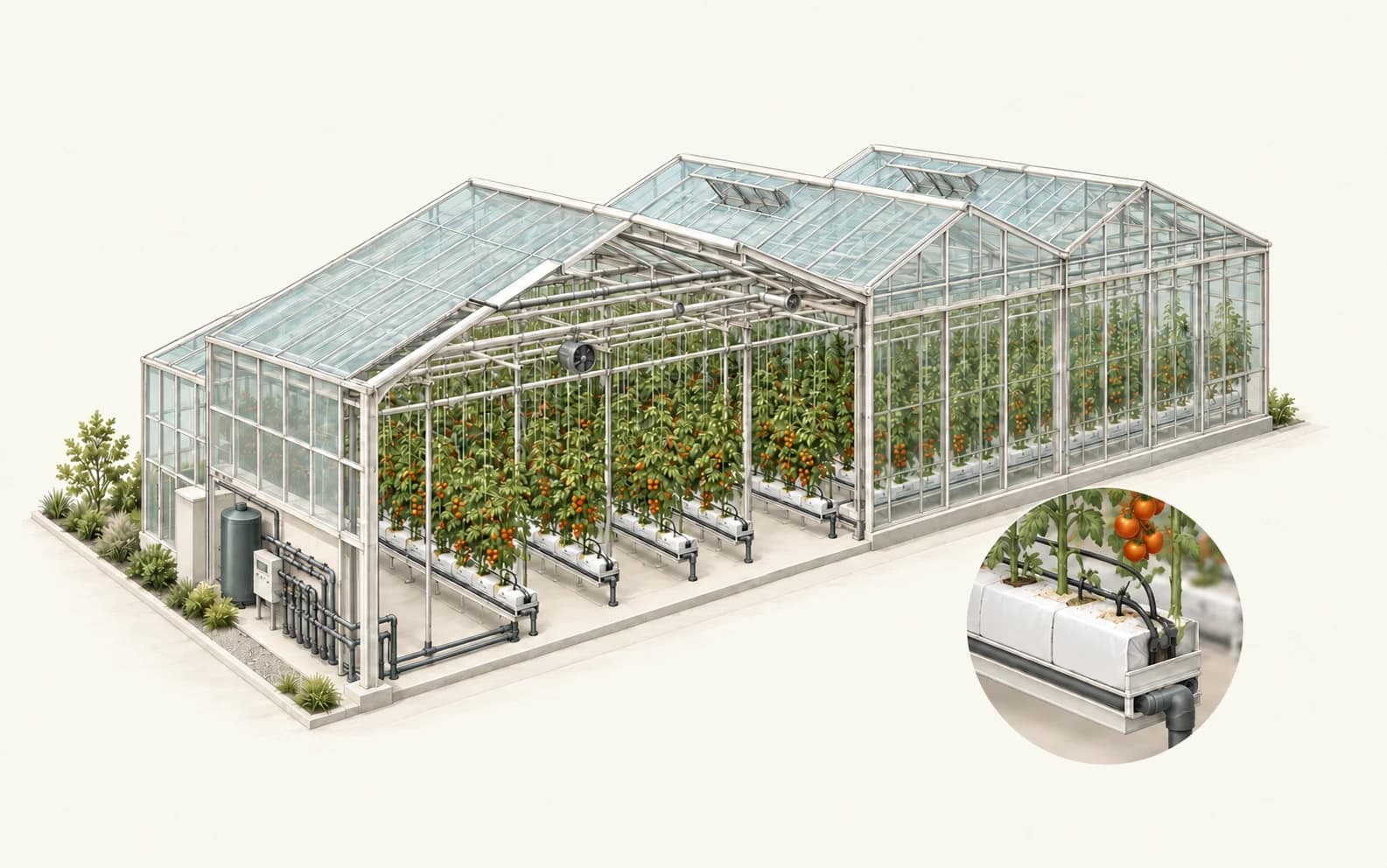
Structure, glazing and ventilation.
Temperature, humidity and airflow.
Contained irrigation and drainage collection.
The design needs to support daily work as well as plant growth: tending crops, checking equipment, harvesting and moving produce into the packhouse. Those movements are considered alongside climate performance.
Read about our approach to light and growing →Irrigation is delivered within a contained growing system. Water that the crop does not use is collected and returned to treatment, rather than draining into the ground.
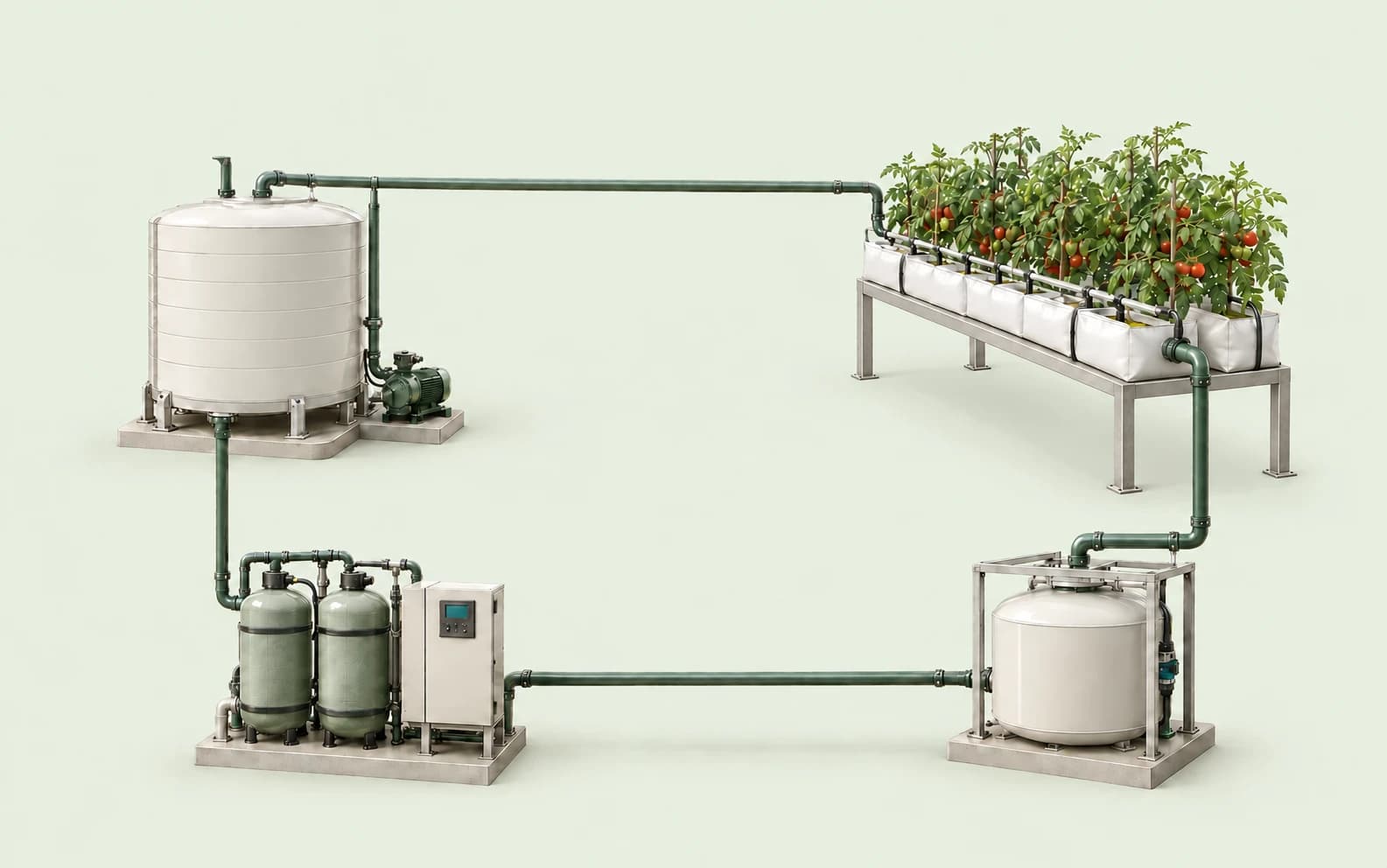
Fresh water replenishes crop use
Collected. Treated. Reused.
Treated water and nutrients.
Contained growing channels.
Capture unused irrigation.
Prepare water for reuse.
↺ Back to storage and supply
Drainage collection is part of the growing system itself. It gives unused irrigation a defined return route from the crop to the water infrastructure.
Returned water is treated and its composition checked before it is supplied again. Water and nutrient management remain connected throughout the cycle.
Recirculation recovers unused irrigation. Fresh treated water is still needed to replenish what the crop uses and what leaves the system through evaporation.
The packhouse and cold chain are part of the campus from the outset. Their capacity and position matter as much as the growing area.
On-site handling reduces the distance between harvest and protected storage. Packing and temperature management are planned for the crop and the customer, while traceability keeps the produce connected to its growing origin.
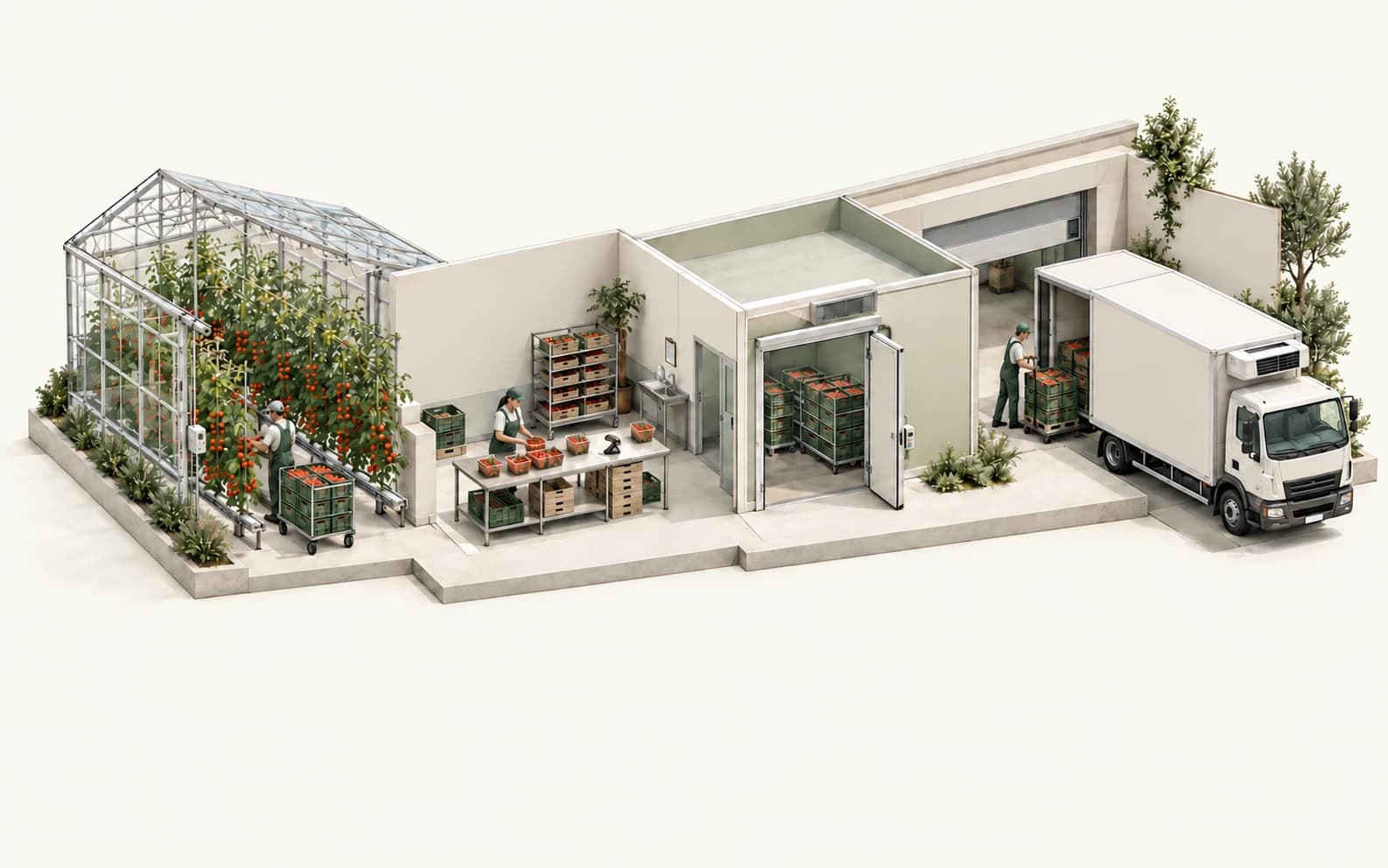
Growing origin recorded
LOT A-014Lot identity retained
LOT A-014Quality protected
LOT A-014Linked to its order
LOT A-014Order Desk connects growing origin with packing, dispatch and invoicing, carrying the production record into fulfilment.
Explore the operating technology →Growing, irrigation, treatment and cold storage create different demands across the day. Energy infrastructure is designed around that combined load.
Solar generation is integrated into the campus plan. Battery storage and any supplementary supply are assessed against the local resource, the operating schedule and the needs of critical equipment. Biomass is considered where reliable local feedstock and a useful thermal demand make it practical.
Buildings and equipment provide the capacity. People, procedures and connected information turn that capacity into a working farm.
Connects climate and farm-performance information to growing decisions, with attention to yield, water, energy and climate risk.
Connects production to orders, packing, dispatch and invoicing so that growing and fulfilment share an operational picture.
Hands-on programmes and Drylands Academy support the skills, procedures and supervision needed to operate consistently.
Maintenance access, equipment checks and the movement of people and produce all belong in the design brief. An integrated campus needs a workable operating plan alongside its physical layout.
The principles carry across locations. The crop plan, infrastructure and development sequence are worked through for each project.
Establish the crop and market opportunity, site conditions, resource availability and intended scale.
Bring greenhouse, water, energy and fulfilment requirements into one technical and operating plan. Test the project assumptions through feasibility work.
Coordinate delivery and check how systems work together, including irrigation recovery, climate control and the harvest-to-dispatch process.
Train the team, establish operating procedures and use production and resource data to guide improvements.
A location, an intended crop or market, and what you know about water and energy are a useful starting point.