Before We Build the Farm, We Test the Decisions
How Drylands connects climate simulation, engineering and financial modelling to test greenhouse-project decisions before committing capital.
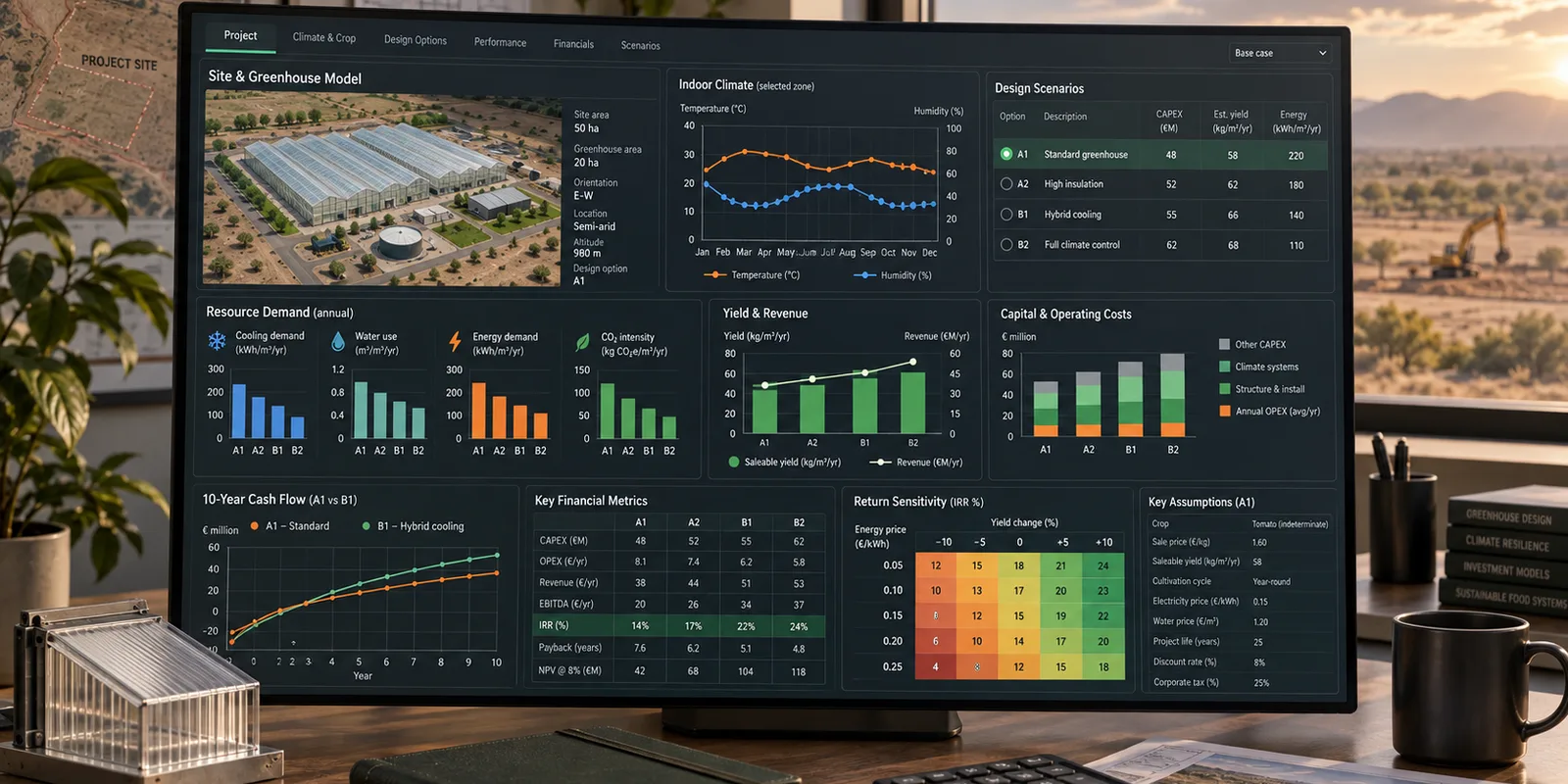
A greenhouse proposal connects decisions about location, crop, structure, climate control, water, energy, markets and finance. Changing one can alter several others. More cooling may improve the growing environment while increasing electricity and water demand. A different crop may change the equipment, labour plan, packing requirements and route to market.
Those connections are easiest to examine before the design is fixed and capital is committed. Drylands uses its Project Developer software to bring climate simulation and business planning into the same decision process. The purpose is not to produce a single impressive forecast. It is to compare credible options, expose the assumptions behind them and identify what the project still needs to prove.
Start with the decision
A useful simulation begins with a defined choice. The team might be comparing two sites, testing cooling strategies for one location or deciding whether a crop and production window can support the intended market.
The alternatives need a common basis. Use the same crop, market requirement and assessment period where possible, then change the variable being tested. If the location, crop, greenhouse and commercial assumptions all change at once, it becomes difficult to explain why the result moved.
Connect climate and commercial variables
The climate model describes the proposed site and growing system: weather conditions, greenhouse geometry, covering, ventilation, shading, cooling, crop assumptions and operating settings. It can then estimate how the internal environment and resource demand respond under the conditions being tested.
Those outputs only become a project decision when they are carried into the business case. Equipment capacity affects capital expenditure. Cooling, pumping and treatment affect operating costs. The crop plan influences saleable output, labour, packing and the timing of revenue. Project Developer keeps these relationships visible so a technical improvement can be assessed alongside its financial consequence.
Compare scenarios, not a single answer
A model is most useful as a comparison tool. A baseline can be tested against alternative structures, control strategies or operating periods. Difficult weather periods should be examined alongside typical conditions, because an annual average can conceal the hours when a design is under the most pressure.
The same discipline applies to the financial variables. Saleable yield, price, energy use, water treatment, staffing, capital cost and the delivery programme all contain uncertainty. Testing plausible changes shows which assumptions materially affect the recommendation and which do not.
Use the model with engineering and operating judgement
Simulation does not replace a grower, engineer or commercial assessment. A technically available system may be difficult to maintain locally. A water source may exist but require treatment, storage or further investigation. A projected crop volume still needs buyers, product specifications, packing capacity and dependable logistics.
Drylands reviews the model results alongside those practical constraints. The team checks where inputs come from, whether equipment assumptions are realistic and which conclusions depend on information that has not yet been verified. Operating evidence from working farms helps challenge assumptions, but it must be applied to the conditions and system for which it is relevant.
Make uncertainty part of the recommendation
A decision-grade result should distinguish evidence from assumptions. Measured weather data, laboratory water results and supplier specifications have a different status from an early yield estimate or an indicative market price. Giving every input the same apparent certainty makes the output harder to use responsibly.
The report should therefore show which findings remain stable across the scenarios, which depend on uncertain variables and what additional evidence would improve confidence. Sometimes the right result is a preferred design. Sometimes it is a smaller next commitment: further site investigation, a buyer trial or a more detailed engineering study.
Commit capital in stages
Good feasibility work turns analysis into a sequence of decisions. It records what was compared, why one option is preferred, what could still change the answer and which conditions must be met before the next expenditure.
That record matters after construction begins. It gives designers, owners and operators a shared view of the assumptions behind the farm and a basis for updating the plan when better information becomes available.
Explore Drylands’ proprietary technology or discuss how climate simulation and financial modelling can support your project-development decisions.