Greenhouse Water Requirements: Irrigation, Cooling and Treatment
Assess total greenhouse water demand, including irrigation, cooling, cleaning and treatment, alongside source quality, storage and supply reliability.
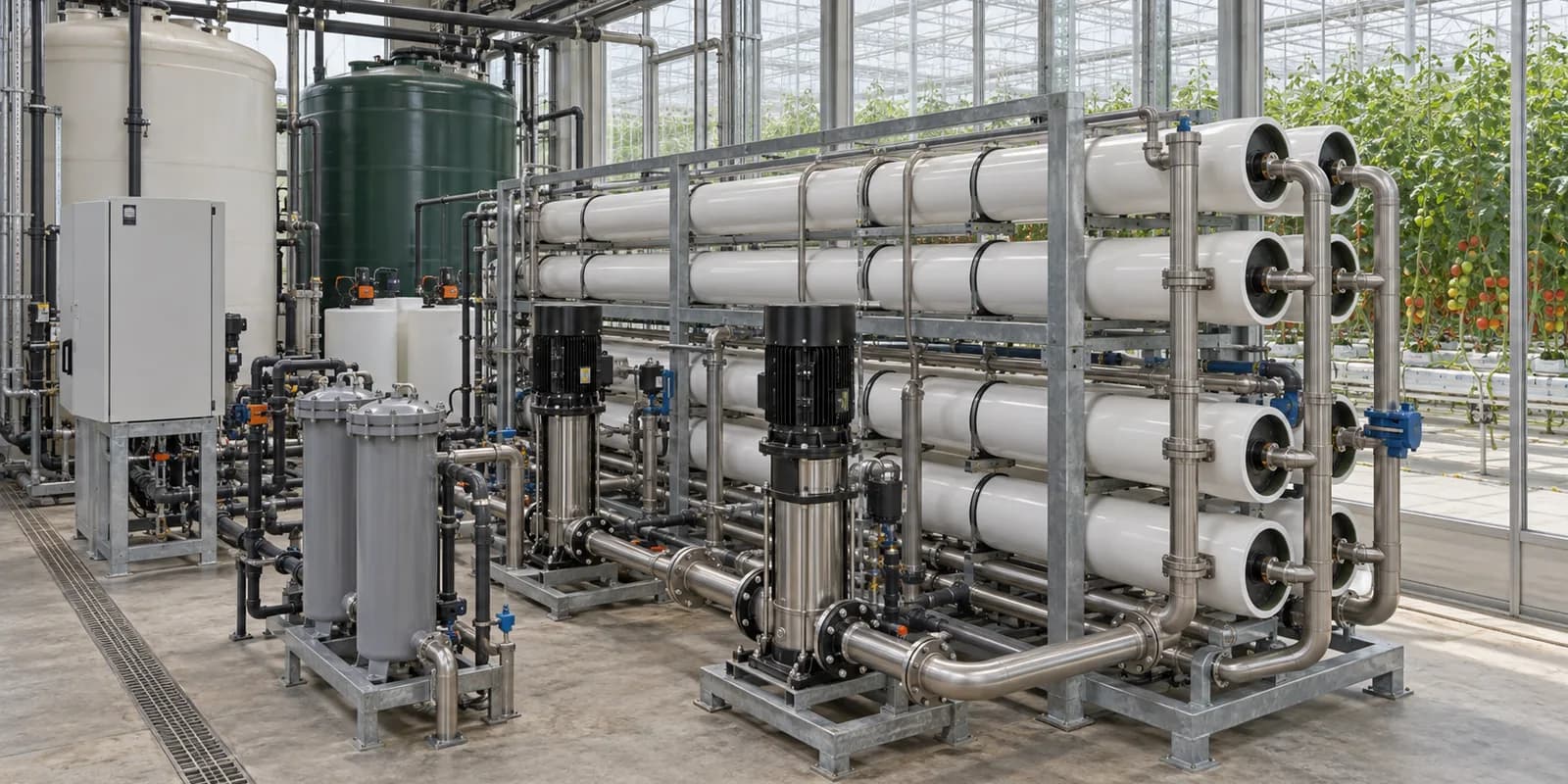
A commercial greenhouse needs a water assessment that covers the whole site. Crop irrigation is one use. Cooling, cleaning, treatment, packing and staff facilities may add others, depending on the design.
The assessment should establish how much water is required, when demand peaks, what quality each use needs and how the farm will operate if supply is interrupted. These questions belong in site selection and feasibility.
Define what is being measured
Water figures are difficult to compare without a clear boundary. Volume supplied to a crop, water collected from drainage, total source water and water used per kilogram of produce describe different things.
For a proposed farm, prepare a balance showing the sources, storage, uses, recovered flows and discharges. State the period covered and avoid counting the same recirculated water as a new input each time it passes through the system.
For an operating farm, identify where meters or other measurements are needed. A single incoming meter gives total demand but may not explain why consumption changes.
Estimate demand for the proposed operation
Build the assessment around the actual crop, cultivation system, growing area and production schedule. Distinguish average use from the peak conditions that determine infrastructure capacity.
List each material demand separately. Where evaporative cooling is proposed, assess its water requirement alongside irrigation. Include the water needed for treatment processes, cleaning and other site activities.
Use a time basis appropriate to the decision. Annual volumes help assess resource use and cost. Daily and shorter periods may be needed to size equipment and storage. Explain how the crop schedule and seasonal climate affect those estimates.
Test the source water
Water quantity does not establish suitability. Obtain a laboratory analysis and have it interpreted for the intended crop, cultivation system and equipment.
Penn State Extension's guide to interpreting irrigation water tests identifies pH, alkalinity, conductivity, hardness, chloride and sodium among the important parameters to assess. The appropriate testing scope for a project should also consider the source, intended uses and relevant local requirements.
Electrical conductivity indicates dissolved salts, but does not identify which salts are present. Similarly, pH and alkalinity are related but different properties. A treatment decision needs more than a single convenient reading.
Establish whether water quality or availability changes through the year. A sample taken at one point may not represent the conditions under which the farm will operate.
Assess reuse within the actual system
Collecting and reusing drainage can reduce the fresh input required by an irrigation system. The design must also address water quality, nutrient management, treatment and the handling of material that cannot be retained in circulation.
A reuse percentage needs a defined denominator. It might describe the share of drainage recovered, for example, rather than the share of the farm's total demand supplied without new water. Those claims should not be used interchangeably.
Keep crop irrigation, cooling and other uses visible in the whole-site balance. This gives the owner a clearer view of where reuse is possible and where fresh supply is still required.
Plan for interrupted or constrained supply
Determine the storage and operating response needed for credible interruption scenarios. Consider the source, treatment equipment, pumps and electricity supply, since a failure at any of these points can affect delivery to the crop.
Storage volume should follow the demand that must be maintained and the period being covered. Include the practical limits on usable storage and the arrangements for restoring supply. A backup source also needs to be assessed for quality and suitability before relying on it.
Confirm the legal availability of the proposed supply with the appropriate local advisers and authorities. Record any conditions that affect the development timetable or operating plan.
Make water a condition of the investment decision
The feasibility report should show the source evidence, estimated demand, treatment scope, storage requirement, operating costs and unresolved risks. If these are material to viability, resolve them before committing to the site or equipment.
Drylands' advisory team considers water alongside climate, crops, energy and market requirements. Discuss your site's water information with us to establish what further investigation the project needs.