Greenhouse Cooling in Hot Climates: Comparing the Options
Compare ventilation, shading and active greenhouse cooling using local heat, humidity, crop needs, water availability and energy costs.
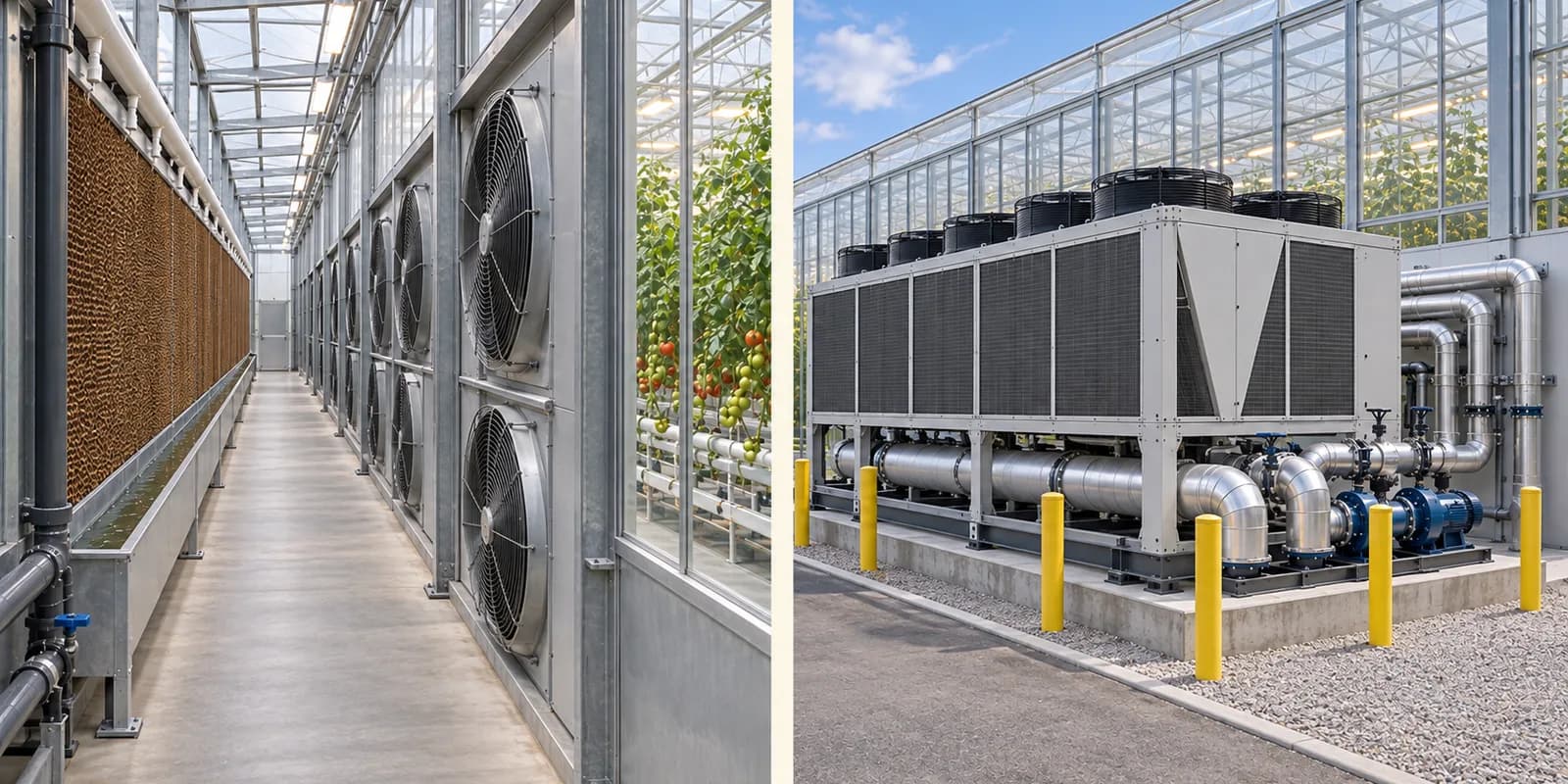
Greenhouse cooling design begins with the site's heat, humidity and solar conditions, then considers what the crop requires and what the farm can supply. Equipment should be selected against those conditions and the proposed production schedule.
The important question is what growing environment a system can maintain, for how long and at what water and energy cost. A supplier's headline cooling capacity does not answer that on its own.
Begin with the greenhouse itself
Review the structure, ventilation openings, covering, screens and crop layout before adding equipment. They influence heat gain and the movement of air through the building.
Natural ventilation relies on the available openings and the forces moving air through them. Its performance varies with conditions, including wind. Mechanical ventilation uses fans to move air, with requirements for electricity, maintenance and an appropriate air path.
Insect screens need to be considered in the ventilation design. Fine screens can restrict airflow, so the openings and fan selection must account for the actual material. The FAO discusses this interaction in its greenhouse design and climate-control guidance.
Use shading with a defined purpose
Shading reduces incoming radiation, but also affects the light available to the crop. Choose the material and operating strategy around crop requirements and seasonal conditions.
Ask when the screen would be used, how much radiation it excludes and how it interacts with ventilation. A fixed treatment and a movable screen offer different operating choices. Assess their effects during less sunny periods as well as the hottest days.
The comparison should explain how shading changes both the growing conditions and the crop-production assumptions. Treating it only as a reduction in cooling demand leaves part of the decision unanswered.
Check the limits of evaporative cooling
Evaporative systems cool air by evaporating water into it. Their cooling potential depends on the incoming air's moisture content as well as its temperature. Hot, dry conditions offer more scope for this process than conditions in which the air is already very humid.
Pad-and-fan and fogging systems apply the principle in different ways. Review airflow, water quality, distribution, control settings and the resulting humidity within the crop. Equipment performance at a test condition should not be assumed to apply throughout the year.
These principles and system differences are covered in the FAO guide's chapter on greenhouse climate control. The site assessment must establish the actual combinations of temperature and humidity against which the system will be designed.
Account for water, electricity and maintenance
Cooling demand forms part of the farm's total resource requirement. Check whether water supply and treatment can support the proposed system during its busiest period while also meeting irrigation and other needs.
Electrical design should include the relevant fans, pumps and controls, together with the arrangements needed during a power interruption. Cleaning and maintenance must be practical for the operating team. Poorly maintained equipment can perform differently from the assumptions used in the design.
If the target climate requires refrigeration or other active treatment, obtain a complete engineering assessment. Include heat rejection, humidity management, energy supply and service requirements in the comparison. The commercial question is whether the resulting production case supports that additional expense.
Compare operating periods and failure conditions
For each design, ask for an assessment of representative production periods and the conditions that put the system under greatest pressure. Establish where the crop's target conditions may not be met.
The report should show the estimated resource demand, the equipment assumptions and the consequences of limited capacity. Review a power interruption, water restriction or equipment fault with the operator. Identify the response available and how quickly it must happen.
Our guide to greenhouse climate modelling explains how simulations can support these comparisons and how to judge their limitations.
Put cooling in the feasibility scope
Cooling choices affect the capital budget, the water balance, power infrastructure and the production plan. Assessing them early gives the project team time to change the design or crop schedule where necessary.
Drylands' advisory services combine technical design with the wider commercial assessment. Discuss your site's climate and proposed crop with us to establish which options merit detailed investigation.